Black Lagoon, Fate Zero, and What We Can Expect from Those Around Us
On moral judgement, expectation, and leadership in Black Lagoon and Fate Zero.

Intro and Black Lagoon
I just finished watching Black Lagoon, a classic early 2000’s crime anime. I enjoyed it, but didn’t adore it. Regardless, in the way that dark and messy 90’s and 2000’s anime tend to, it brought up a few thought-provoking themes. Now that I don’t have a job, I’ll use some of the spare compute to think about them.
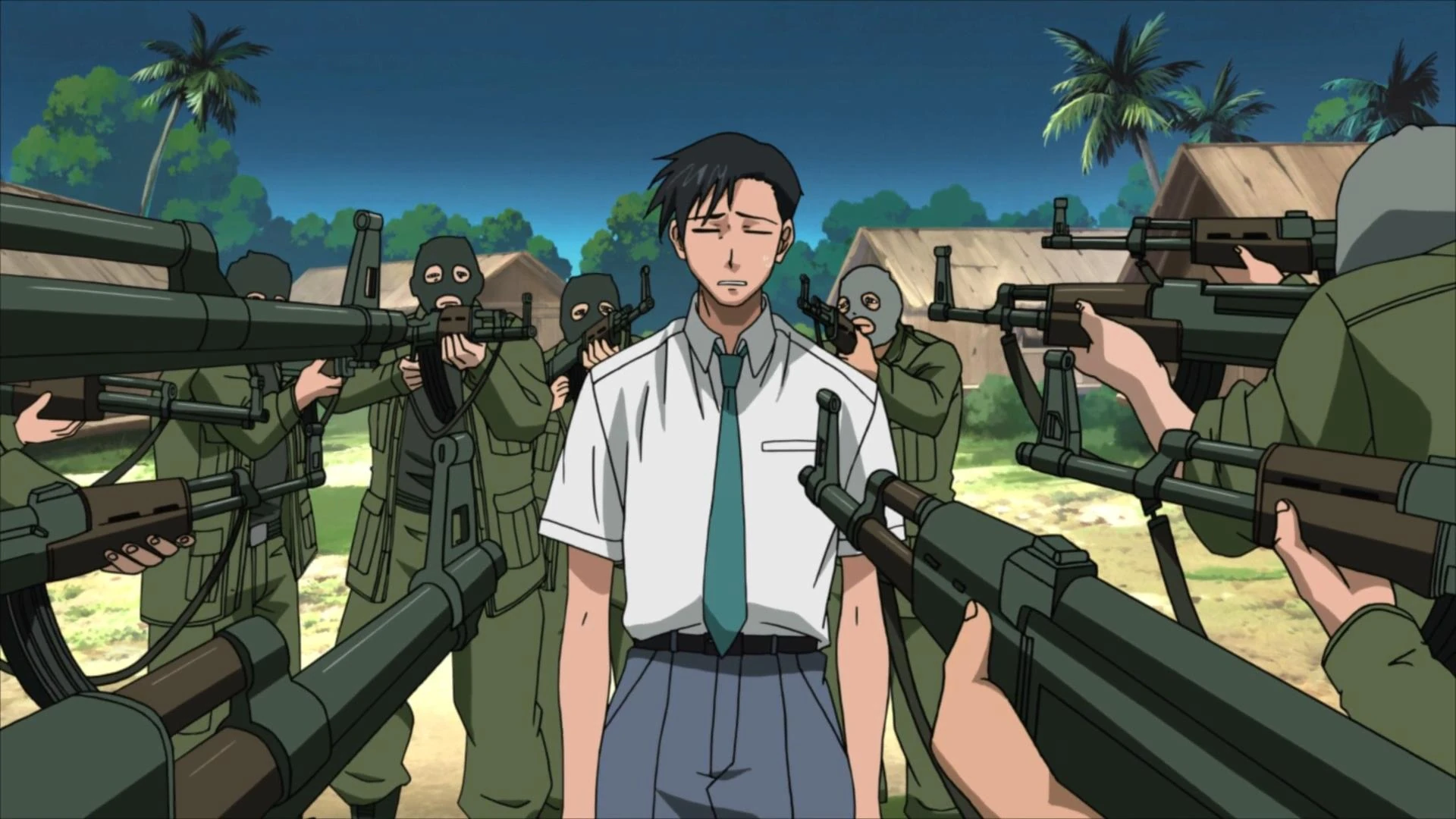
Black Lagoon follows Rock, a Japanese salaryman who flees his dismal life as a corporate slave, not via reincarnation (for once!), but by joining a troupe of pirate smugglers who kidnap him suddenly at the start of the show. Rock savors his newfound freedom as one of the four members of the “Lagoon Shipping Company” while navigating a world devoid of morality and saturated with violence. He becomes best friends with Revy, the other star of the show and one-woman army capable of singlehandedly turning large groups of people into puddles of gore with her trusty dual-wielded pistols. If Rock represents the standpoint of the viewer, Revy embodies the world of sin the show claims as its setting. The show is typical of its genre of anime produced during Japan’s “Lost Decades”, awash with gratuitous violence, sex, badassery, and general twistedness. What sets it apart is that its narrator is not native to the show’s environs, but rather to the viewer’s. This brings to the forefront questions of who has a right to pass moral judgement upon someone, and how that judgement ought to be delivered. As the show puts it, Rock lives “in the twilight” between moral systems, and struggles to walk that narrow road between them.
At several points in the show, Rock tries to impose his more conventional morals on Revy and other characters of the criminal underworld. At one point, when Rock and Revy are scavenging a derelict, corpse-filled submarine, Rock asks Revy to leave behind the dead’s medals out of respect rather than taking them to sell. Revy promises to kill him if he says something like that again. Later, Rock tries to convince a young girl who has inherited leadership of her family’s yakuza gang to give up on her position and run away. She rebukes him, telling him he lives in the “twilight” between his old world and hers. She’s effectively saying, “you have no right to judge.” In some of these moments, Rock seems like a complete asshole. He has voluntarily adopted a life of crime, abetting in all manner of misdeeds, and yet he insists on correcting his criminal peers who come from backgrounds far less comfortable than his own.
Despite his unwelcome proselytizing, Rock manages to earn the respect of much of the show’s criminal cast. He becomes a translator and advisor to the Russian crime boss Balalaika, and ends up Revy’s inseparable companion by the second half of the show. No matter how many times he gets himself in sticky situations, many of his own making, Revy puts her life on the line to rescue him. Some of this respect Rock earns through capability. For most of the team’s jobs, Rock proves himself resourceful and brave, making a genuine contribution to the team. The more subtle way is that Rock gets better at passing moral judgement tastefully. As the show progresses, Rock learns to keep his mouth shut more often around Revy’s violent excesses and continues to respect her. There’s one heartwarming scene where Rock and Revy are in the midst of an argument complemented by the occasional punch and gunshot, when Rock more or less says the reason he’s mad at Revy is because he’s grateful to her for liberating him from his life of corporate servitude and wants her to act like someone he can respect. When he does push other characters in directions aligned with his outsider values, he starts finding ways to incentivize involved parties into doing what he wants them to. This kind of scheming is something people like Revy or Balalaika can understand and respect.
Judgement and Expectation
Situations begetting questions of how and when to pass judgement happen all the time in the real world. I’ll take an example from recent news. In May 2026, an Ebola outbreak gained traction in the DRC. MSF took measures to counter the spread of disease by quarantining the infected and deceased. Some local residents, angry that they were unable to perform proper burial rites for their loved ones, burned MSF tents and attempted to take back some of the infected bodies. The news is obviously frustrating. The arsonists’ actions put themselves, their loved ones, their whole community, and the MSF doctors who are just trying to help all in danger. At the same time, with context, their actions are understandable. Due to poverty and lack of education, they probably don’t know much about viruses, the spread of disease, and the measures that counter it. What they do know is their country has been ravaged by outsiders for generations, and some of those outsiders just stole their dead friends and families. Opining from privileged positions in the West, what right have we to judge? In many ways, none. We are not products of the centuries of hell that have plagued much of subsaharan Africa; in fact, we are much more affiliated with the makers of that misery. At the same time, absolving those who burned the tents of any blame or judgement is infantilizing. It denies the perpetrators of agency, expecting them to be nothing more than products of the environment they inhabit.
This kind of conundrum plagues fields that seek to understand and support people, from anthropology to charity to counseling to criminal justice. Rock embodies this struggle, and sometimes, in his best moments, gives us glimpses of a way to walk the line between judgement and dismissal that is more productive than either extreme. To take the DRC example, neither MSF pulling out of the country altogether nor relying on violent enforcement alone are terribly productive. Messy approaches that involve a mix of reducing presence, protecting doctors by force, and educating local residents about the disease may not feel decisive, but are more likely to result in useful outcomes for everyone involved. Similarly, a counselor ought to understand the context that drives their patient to act the way they do, but at the same time should gently push their patient in a direction that results in less harm to the patient and others around them. Reducing crime entails both punishing those who commit it and improving their circumstances so they are less likely to want to the next time. The theme remains true across domains.
Zooming in further, we run into this conflict in everyday life with the question, “what do I get to expect from other people?”. The question plays a central role in all relationships: friends, coworkers, mentors, lovers, parents, and so on. We invent all manner of systems to navigate it (religious moral guidance, the legal system, marriage, chore lists for kids) and even more subtle ways of thinking that simplify the problem (boundaries, needs, prioritizing oneself). On one hand, expecting nothing from others can be demeaning. It expects nothing of them and deprives them of agency. On the other hand, expecting the world from someone else can be horribly oppressive. Most athletes with harsh coaches or children of tiger parents could testify to the burden of striving to meet others’ expectations. Finding a healthy balance between acceptance and expectation is difficult.
Expectation in Leadership and Fate Zero

To take it back to anime, Fate Zero, which may be my favorite piece of media full stop, illustrates this beautifully. In the show, Artoria, the woman who (in Fate’s universe) posed as a man and ruled England under the name King Arthur, discusses with Alexander the Great the meaning of leadership. The discussion takes place in the present day, so both can reflect on their full lives and legacies. Artoria strove to be the perfect king. She took the burdens of her people upon herself, living the motto “a king serves his people.” She never showed weakness, anger, or exhaustion, all while performing immense labors to save her kingdom. She even erased her identity as a woman to be a more acceptable leader in that time and place. In the end, she was betrayed by her most loyal knights, slaughtered as a reward for her unfailing service. Alexander, meanwhile, was a king served by his people. He led them not because he was the one who could best provide for them, but because he was the greatest, the greediest, the most able, and dreamed the biggest. He swept up his nation in his grand dream to conquer his way to the Pacific Ocean, leading one of the most successful military campaigns in history. He rewarded loyalty and treated his people fairly, but at the same time made the hierarchy eminently clear. He was king, and all beneath him had to follow.
What’s fascinating to me is that most of us would love to believe that Artoria’s version of leadership is best. It aligns clearly with values of kindness and generosity. And still, her method of leadership led to collapse. She expected nothing of her people and everything of herself. She never made them feel like capable individuals who could be relied on by their king. Perhaps of equal importance is that her attempts to do everything for everyone without faltering made her unrelatable to her followers to the point they could no longer understand her as a person. Doing so much work for others while expecting nothing in return and never showing any strain or unhappiness may be admirable, but it is also striving for something that is innately inhuman. It would be nice to think she was leading by example, but when that example seemed unattainable to those beneath her, it ceased to be a source of inspiration and instead was read as Artoria thinking she was better than everyone else. That isn’t to say that Alexander’s way of leading is correct. He exhibits little of the benevolence that is most important in a good ruler. Rather, the takeaway is that Artoria needs to take one purposeful step in Alexander’s direction. She needs to expect something from her people and maybe even a bit less from herself.
It took me several years and two watchings to grasp the significance of Artoria and Alexander’s talk. It wasn’t until the end of college, when I was reflecting on my legacy of miserably carrying far too many group projects, that it hit me what Fate was trying to say. Most group projects in college went the same way for me. I would put in the level of effort I always expected from myself, which was invariably more than my groupmates. Whenever they would falter, missing a deadline, taking on less than their fair share, or writing buggy code, I would calmly pick up the slack and do the work myself. Most of the time, I wouldn’t complain to them, tell them to do a better job, or even act like I was bothered at all. When someone would say “I’m really busy this week and it’s affecting my mental health, so I’m not going to work as much,” even though I knew my calendar was twice as jammed as theirs, I’d smile and say “no problem, I got it.” It stunned me how quickly groupmates would catch onto this aspect of me, and as if on command, cease all productive activities. While thinking that I was being kind and leading by example, in effect, I was a remarkably disempowering teammate, albeit one that guaranteed you an A. I had fallen into the same trap as Artoria. I treated my groupmates as well as could be, but at the same time could not help but lose respect for them. No matter what they might say, the fact they would leave so much work to me implies they did not respect me much either.
Years later, I’m still trying to figure out what it looks like to lead or collaborate in a manner that values kindness while producing quality results and elevating those around me. I found it deeply relieving to find on my team at Roblox that when everyone is a competent Artoria, everything goes swimmingly. But this is a rarity and far from the norm. With each passing year, I notice more ways the questions of “what should I expect from myself?” and “what should I expect from others?” dictate the fibre of all manner of interpersonal relationships. As these questions by necessity have no right answers, I hope to find ways of living them that are kind to others and myself, and produce results I can be happy with. I haven’t finished watching Black Lagoon’s final season, but it seems like Rock is still working on it.
Acknowledgements
I used ChatGPT and Claude for feedback but all the writing is mine.
Discussion
OMG there's even a chat, this is basically Reddit